
This article contains affiliate links. We may earn a commission if you buy through them, at no extra cost to you.
Rice Cooker vs. Instant Pot vs. Stovetop for Plant-Based Weeknight Dinners
Meta description: Compare a rice cooker, Instant Pot, and stovetop for plant-based weeknight dinners. See how each handles grains, beans, soups, and one-pot meals, and which suits your cooking style.
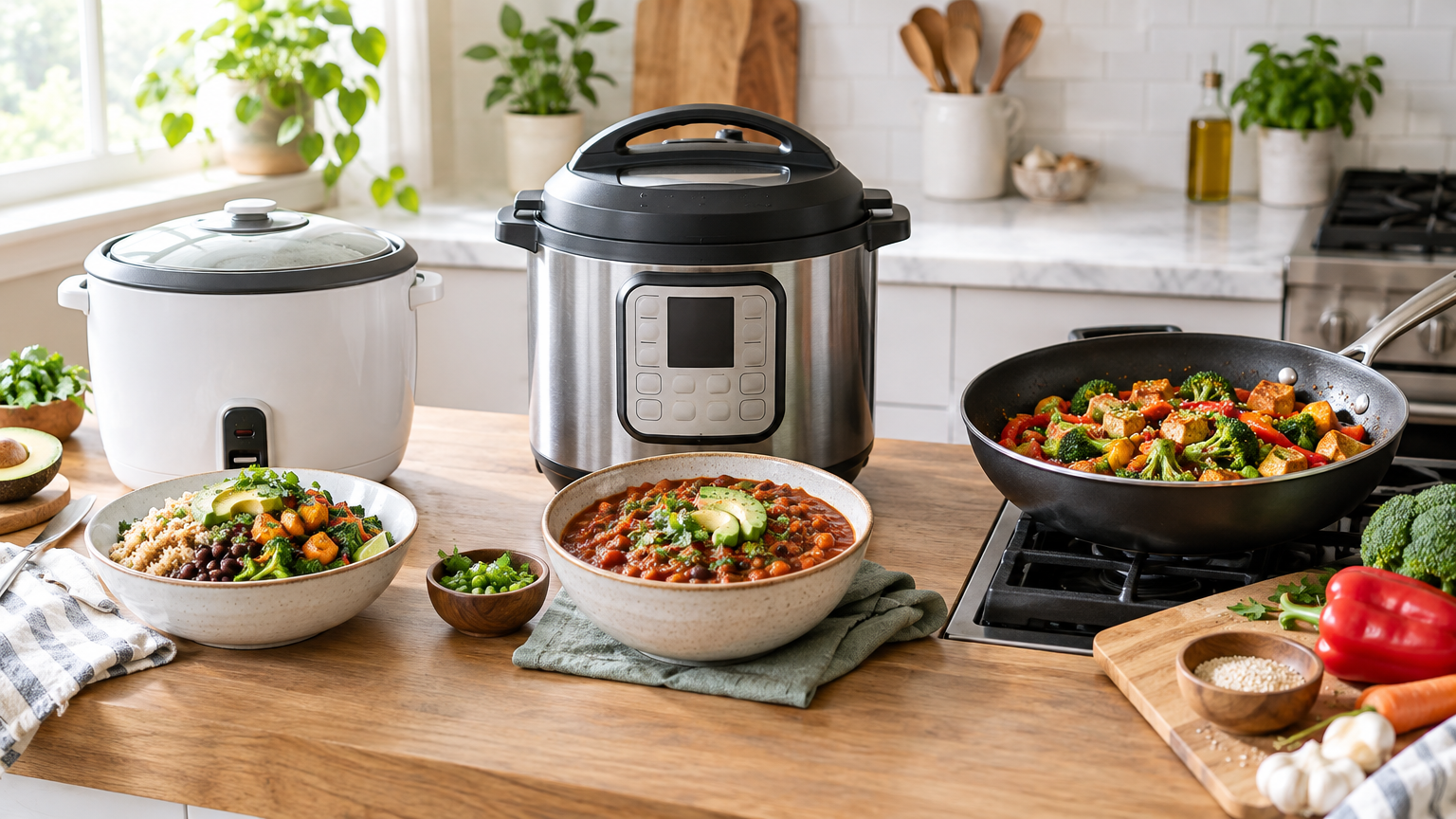
Weeknight plant-based cooking tends to revolve around grains, beans, soups, and one-pot meals, and each cooking method handles those categories differently. This guide gives you a simple framework for comparing a rice cooker, an Instant Pot (or similar multi-cooker), and a regular stovetop, so you can settle the rice cooker vs instant pot for plant based meals question based on how you actually cook. It's written for people deciding what to buy, or which tool to reach for, before committing counter space and budget.
Key takeaways
- A rice cooker is the simplest, most focused option for hands-off grains and easy sides.
- A multi-cooker like the Instant Pot covers the widest range of plant-based dinners but asks more of you up front.
- The stovetop offers the most control and costs nothing extra if you already own pots.
- Many households end up using two methods. Your most-cooked meals should drive the decision.
Quick Answer: Rice Cooker vs Instant Pot for Plant-Based Meals
- Rice cooker: Best if you mostly want hands-off grains and simple sides.
- Instant Pot (multi-cooker): Best if you want one appliance for beans, soups, and one-pot meals and don't mind a learning curve.
- Stovetop: Best if you want maximum control, already own pots, or have a tight budget and limited storage.
There's no universal winner. The right choice depends on what you cook most often and what frustrates you most about weeknight cooking.
How We're Comparing Them
This is a framework-based comparison built on general feature descriptions, not lab testing or brand-specific performance claims. That keeps it useful across many models.
The four meal categories
1. Grains: rice, quinoa, millet, oats 2. Beans and lentils: dried or canned, as a main or a side 3. Soups and stews: brothy, blended, or hearty 4. One-pot meals: grain bowls, curries, chili, pilafs
The four decision factors
1. Counter space: where it lives and how much room it takes 2. Learning curve: how quickly you'll feel confident 3. Versatility: how many of your regular meals it can handle 4. Cleanup: how many parts and pans you'll wash
A note on models: Features, capacity, settings, and safety guidance vary by model. Check the manufacturer's manual before relying on any function described here.
Side-by-Side Comparison Table
| Counter space | Learning curve | Versatility | Cleanup | Best for | |
|---|---|---|---|---|---|
| Rice cooker | Compact to moderate; single-purpose | Low | Narrow; focused on grains and simple dishes | Typically a removable inner pot and lid | Set-and-forget grain eaters |
| Instant Pot / multi-cooker | Moderate to large; multi-function | Moderate; more settings and parts to learn | Broad; grains, beans, soups, one-pot meals | Inner pot plus lid and sealing ring | Batch cooks and one-appliance fans |
| Stovetop | None extra; uses existing burners and pots | Familiar, but most hands-on | Broadest in principle, with your own attention | Depends on how many pots and pans you use | Hands-on cooks and budget-conscious kitchens |
Performance by Meal Type
Grains (rice, quinoa, millet, oats)
- Rice cooker: This is the task it was designed for. It's typically a simple, set-and-walk-away process, which frees you up to prep vegetables or tofu while the grain cooks.
- Instant Pot: Many models include rice or grain settings. It's flexible, but there are more options to learn, and you'll want to follow the manual's liquid and setting guidance.
- Stovetop: Reliable once you know your pot and burner, though it needs attention to heat and timing.
Example: If Monday through Thursday looks like "grain plus roasted vegetables plus a sauce," a rice cooker handles the grain while you handle everything else.
Beans and lentils
- Instant Pot: Pressure cooking is a main selling point for dried beans. Follow the manual closely, since bean preparation and safety guidance matter here.
- Stovetop: Familiar and flexible, but it needs monitoring, and you manage the simmer yourself.
- Rice cooker: Generally not the primary tool for dried beans. Check your model's guidance rather than assuming it can.
Example: If you like cooking a big pot of chickpeas on Sunday for the week, a pressure-capable multi-cooker or a patient stovetop approach both work. The difference is whether you'd rather stay nearby or press a button.
Soups and stews
- Instant Pot: You can sauté aromatics and then cook in the same pot, which cuts down on dishes.
- Stovetop: It's easy to taste and adjust as you go, which many cooks prefer for seasoning and thickness.
- Rice cooker: Limited, depending on the model. Some have additional settings, but it's rarely the first choice for soups.
One-pot meals (grain bowls, curries, chili, pilafs)
- Instant Pot: Combines sauté and cook functions, so a curry or chili can go from onions to finished dish in one vessel.
- Stovetop: Offers the most control over texture and layering, such as toasting spices, browning, and adding ingredients at different stages.
- Rice cooker: Works for simple rice-based dishes with added vegetables or legumes, depending on the model.
Key Decision Factors
Counter space and storage
A rice cooker is usually the smaller appliance, though it still needs a home. Multi-cookers are generally bulkier and may need cabinet storage if you don't want them out all the time. The stovetop wins here because it uses equipment you already have. Measure your space before shopping, and compare the dimensions listed for specific models.
Learning curve
The rice cooker is the gentlest: add grain and water, press a button. A multi-cooker has more buttons, modes, and safety features, so expect to read the manual and run a few trial meals. The stovetop has no new gadget to learn, but it asks the most from you in the moment. You'll adjust heat, watch for boiling over, and judge doneness.
Versatility
The multi-cooker covers the most categories in one appliance. The stovetop is arguably just as versatile since it can do anything your cookware allows, but it requires your active attention. The rice cooker is the most specialized. It's excellent at its main job but a limited fit for beans, soups, and varied one-pot meals.
Cleanup
- Rice cooker: A removable inner pot and lid are often simple to wash, though some models have extra parts.
- Multi-cooker: The inner pot is usually easy to clean, but the lid and sealing ring need regular attention, since ingredients like curry spices and onions can leave residue.
- Stovetop: Cleanup depends on how many pots, pans, and utensils you use. A one-pot soup is easy. A three-pan dinner isn't.
Which Appliance Fits Which Type of Cook?
- The "set it and forget it" cook: A rice cooker. You get consistent grains without monitoring.
- The batch-prep and meal-prep cook: A multi-cooker. Beans, soups, and one-pot meals can all come from a single appliance.
- The hands-on, taste-as-you-go cook: The stovetop, for full control over seasoning, texture, and timing.
- The small-kitchen or budget-conscious cook: The stovetop, or a single multi-use appliance if you want to consolidate gadgets.
- The beginner: The stovetop if you already own pots, or a rice cooker for simplicity. A multi-cooker is manageable if you're willing to read the manual first.
- The household cooking for a crowd: Capacity matters most. Check the stated capacity of any model you're considering [VERIFY per model], and compare it to the largest pot you own.
If you're leaning toward a multi-cooker, you can browse multi-cooker options and compare capacities and settings before deciding.
How to Choose: Practical Steps
1. List your five most-cooked plant-based dinners. 2. Sort them into grains, beans, soups, or one-pot meals. The category that dominates your list points to your best fit. 3. Note your biggest frustration: time, attention, cleanup, or space. 4. Measure your counter and cabinet space. 5. Check the features and capacity of the models you're considering. 6. Read the manufacturer's instructions for beans and other legumes, especially for pressure cooking. 7. Start with one appliance. Add another only if a clear gap remains.
If your list is mostly rice bowls with simple toppings, a rice cooker designed for everyday grains may be all you need. If you're still building your plant-based basics, our beginner plant-based pantry guide can help you pick which staples to cook first.
Common Mistakes to Avoid
- Buying a multi-cooker but using only one function. If you only ever make rice, a simpler appliance may serve you better.
- Assuming one appliance replaces all others. Even versatile appliances have tradeoffs, and many cooks keep a stovetop in the mix.
- Skipping the manual. Safety, care, and legume guidance vary by model, and pressure cooking in particular calls for following instructions.
- Ignoring cleanup differences. A tool you dread washing is a tool you'll stop using. Compare parts, not just features.
FAQs
Can a rice cooker replace an Instant Pot for plant-based cooking?
For grains and simple dishes, possibly. For beans, soups, and varied one-pot meals, a multi-cooker or stovetop is typically more versatile. It depends on your model's features, so check the manual.
Is an Instant Pot better than the stovetop for beans and lentils?
It depends on your priorities. A pressure cooker offers hands-off convenience, while the stovetop offers control and needs no extra equipment. Follow manufacturer guidance for either method.
Which is easiest to clean?
Appliances with removable inner pots are often simple to wash, but sealing rings and lids need attention in multi-cookers. Stovetop cleanup depends on how many pots you use.
Final Recommendation
The rice cooker vs instant pot for plant based meals decision comes down to how you cook:
- Choose a rice cooker if grains are your foundation and you value simplicity.
- Choose an Instant Pot or multi-cooker if you want one appliance for beans, soups, and one-pot meals and you're willing to learn it.
- Choose the stovetop if you want control, already own the cookware, or are working with a limited budget and storage.
Many cooks end up combining methods, such as a rice cooker for grains with a stovetop for everything else. Start with the one that fits your most common meals, and expand only if you hit a real gap.
Ready to narrow it down? Use the steps above as a buyer's checklist, and revisit our beginner plant-based pantry guide to plan the first few meals you'll cook.